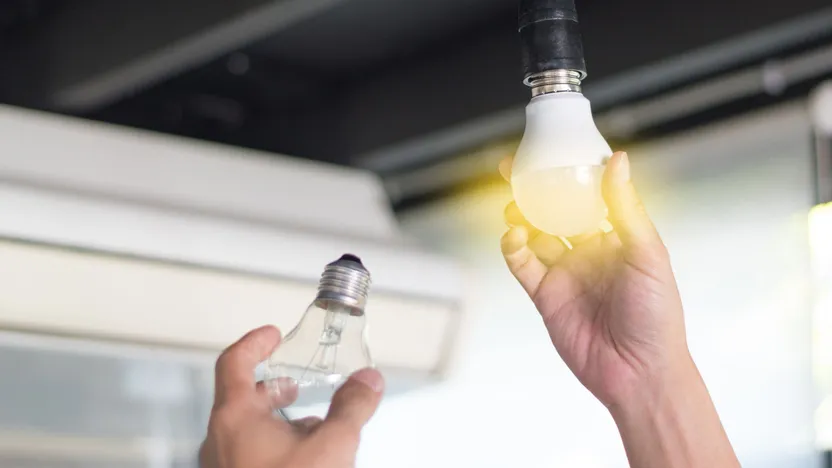
LED light bulb buying guide
'/%3E%3C/svg%3E)
Guide written on 6 February 2024 by:
Tess, painting & decorating consultant, Brighton
Important features
- Base type
- Beam angle
- Wattage
- Light output
- Light intensity
- Colour rendering index
- Colour temperature
- Dimmable bulbs
- LED smart bulbs
- Decorative bulbs
LED bulbs: features and uses
Advantages of LED bulbs
LED light bulbs have more or less replaced older styles of bulbs in recent years. This is mainly thanks to the fact that LED bulbs offer three important benefits:
They consume very little energy.
They barely heat up.
The bulbs light up instantly.
How to choose an LED bulb
Nevertheless, choosing an LED bulb can be tricky since factors like shape, base type, power and CRI all vary between bulbs. Picking the right LED bulb comes down to identifying your needs in terms of:
base type;
beam angle;
energy;
luminous flux;
efficiency;
colour rendering index (CRI);
visual comfort:
colour temperature;
compatibility with dimmer switch.
Please note: LED technology can be used to make smart bulbs and/or decorative bulbs.
LED bulb
LED bulb bases
LED bulbs come in all different bulb base types:
E27 (large threaded base) bulbs are usually used for main overhead lights in the house;
E14 (small threaded base) bulbs are usually used for bedside and desk lamps.
B22 (bayonet) bulbs are installed slightly differently to threaded bulbs. Instead of screwing in the bulb, you need to press it down before rotating it a quarter or half turn.
GU10 bulbs are installed just like B22 bulbs (though they have a different base);
GU3, GU4, G24, G9, R7s and MR16 all feature pins in their bases.
Please note: LED bulbs are wider than halogen bulbs so be sure to check you have enough room to install an LED bulb.
B22 LED bulbs
Beam angle
It's important to take note of the beam angle when choosing a bulb. The narrower the beam angle, the more concentrated the light will be. A narrow beam angle can therefore be used to highlight an object or specific area you want to draw attention to. If you are installing a downlight, for example, there's no point in fitting a bulb with a 360° beam since these bulbs are limited to a beam angle of about 90°. On the other hand, if you are installing a main light (a pendant light for example) or if you are fitting a bulb without a lamp shade, it's best to go for a wide beam angle to ensure every corner of the room is lit up.
E27 LED light bulbs
LED bulb energy
Traditionally, energy use was measured in watts. But since LED bulbs are low watt, this is no longer a reliable metric. Instead, energy-efficient LED bulbs are measured in lumens which indicates brightness.
Visual comfort: lumens, lux and CRI
Lumens
Light output is measured in lumens (lm). This value indicates the amount of light a light source can emit.
For ambient lighting and a cosy feel, 500 lumens will be more than enough.
For brighter lights go for 600 to 700 lumens.
For a ceiling light, 1000 to 1500 lumens will work best.
Watts to lumen conversion in incandescent bulbs
Light output in lumens | Equivalent wattage |
≈ 300 lm | ≈ 30 W |
≈ 500 lm | ≈ 40 W |
≈ 700 lm | ≈ 60 W |
≈ 1000 lm | ≈ 75 W |
≈ 1250 lm | ≈ 120 W |
≈ 2000 lm | ≈ 250 W |
Light level intensity in lux
The light intensity of a bulb is indicated in lux (lm/m²). This value should be chosen to match your lighting needs which will vary depending on the room. To pick the right bulb, remember the following:
400 lux will suffice for a living room;
an office or workshop will need 200 to 900 lux (bearing in mind that the more intricate the work, the more light intensity is required);
200 lux is best for a bathroom
a hallway will only need about 80 to 100 lux.
Colour rendering index (CRI)
Visual comfort also depends on the colour rendering index which is based on a scale of 1 to 100 (100 being the closest to natural light and providing the most faithful rendering of colours).
LED bulbs usually have an CRI of 70 to 80.
Tube lights
Colour temperature: warm to cool lighting
Colour temperature determines the colour emitted by your light bulb and is measured in Kelvins. This is important when it comes to thinking about the kind of atmosphere you want to create in a room.
Warm white: Recommended for a relaxing, intimate and warm feel; orange to yellow in tone. < 3000 K
Neutral: Recommended for kitchens, bathrooms and work spaces; similar to natural light. 4000 > K < 5000
Cool white: Recommended for the type of bright lights used in lobbies, factories, or hospitals. > 6000 K
Light bulb
Dimmable bulbs for dimmer switches
Be careful – not all LED bulbs are designed to work with dimmer switches. For this, you'll need dimmable bulbs. This information will be noted on the box, usually as a circle containing an arrow. This logo indicates that the bulb is designed to cope with changes to the voltage waveform.
Using a standard LED bulb with a dimmer switch may cause the bulb to burn or flicker, and its lifespan will be greatly reduced.
Smart bulbs for enhanced user comfort
Some bulbs can be controlled via remote control or using a smartphone. This allows you to adjust the intensity of the light to any situation.
This system can also be used to change the colour of your light bulb which is ideal if you like to switch up the feel of the room to match your mood!
Smart bulbs
Decorative bulbs: for attention to detail
These days, light bulbs also play a decorative role in the design of a room. With this in mind, you'll find a range of models designed to look just like old-fashioned filament bulbs. These transparent bulbs leave the wire coil of the bulb on show and produce a warm orange light for a cosy feel.
You may be also interested in these guides
Guide written by:
Tess, painting & decorating consultant, Brighton
'/%3E%3C/svg%3E)